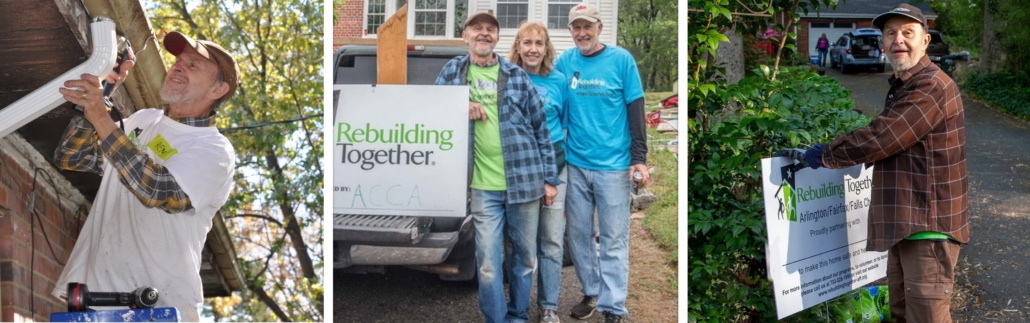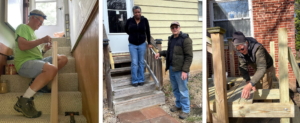
From a Cooling Crisis to a Safe and Healthy Home

Last August, a referral from Fairfax County’s Senior Cool Care program led us to Ms. S, an extremely low income condo owner facing the peak of summer without air conditioning. Although she had received a portable AC unit through Cool Care, she wasn’t able to install it on her own. That’s when our AC Rescue team stepped in.

When our AC Rescue team arrived, what began as a simple cooling fix quickly revealed a much larger need. Not only was the AC unit not in use, but nearly half of the condo’s electrical outlets weren’t working. After some careful troubleshooting, our team discovered tripped breakers and restored power that same day—bringing immediate relief as we installed the portable AC and cooled the home for the first time in months.

But the challenges didn’t stop there.

At the same time, other serious issues were impossible to miss. The condo had sustained significant damage from a water leak in the unit above—leaving holes in the ceilings, missing baseboards, and carpeting pulled up in an attempt to dry it out. It was clear Ms. S needed more than a quick AC unit install; she needed a safe and healthy home.

Our RT Express team quickly mobilized, assessing the home and developing a comprehensive plan. Over the following weeks, 12 volunteers worked together for 124 hours to transform the condo—patching and painting ceilings, repairing plumbing, and restoring functionality to the kitchen with a new garbage disposal, dishwasher, microwave, and lighting. In the bathroom, grab bars were installed for safety, while damaged flooring in the entryway was replaced and LED bulbs were installed in all light fixtures. Carpeting was refastened, and new baseboards brought the space back together.

Meanwhile, our AC Rescue program brought in a contractor to evaluate the central air system, which was ultimately deemed too old to repair. By combining available funding sources, we were able to take the unusual step of replacing the exterior unit entirely—ensuring Ms. S now has reliable, whole-condo cooling in time for the summer ahead.

In total, our volunteers resolved 10 critical health and safety issues, bringing Ms. S’s home into alignment with all 25 of Rebuilding Together’s Health and Safety Priorities.

What began as a call for help with a single air conditioner became a comprehensive effort to restore a safe, healthy, and comfortable home—with critical cooling support ensuring Ms. S is also protected from heat-related illness.

Thanks to your support, her home is now a place of safety and stability—and with summer around the corner, she can stay cool, secure, and at ease.

Team Leader Profile – Lander Allin

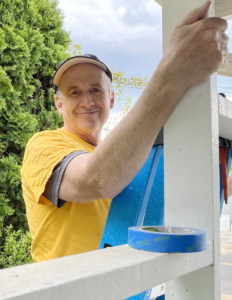
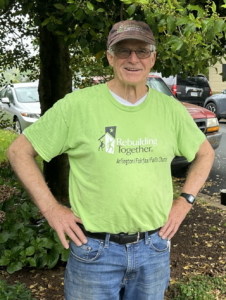
Lander AllinArlington, Va., is known for its leafy historic neighborhoods, lively commercial corridors and excellent public schools. Lander Allin’s impressive history of civic involvement has contributed to all of them.

Lander, a Team Leader for Rebuilding Together-AFF, has served as president of his neighborhood Alcova Heights Civic Association, president of the Columbia Pike Revitalization Organization (now called the Columbia Pike Partnership), and a member of the Public Facilities Review Committee helping to plan Arlington public schools. He also worked on a campaign to develop a streetcar line along Columbia Pike. Most recently, he served on the Career Center Working Group, which developed recommendations to add 700-800 high school students to schools in a limited, two-block area of Arlington.

Lander’s career has melded lifelong interests in urban planning, community development and public service.

Raised in Richmond, Va., where his father was a vice president of the Federal Reserve Bank of Richmond, Lander earned a bachelor’s degree in American government and a master’s in urban planning from the University of Virginia. After graduate school in 1982, he worked for the Fairfax County Housing and Community Development Dept., planning curb and gutter, sidewalk, and storm water infrastructure for older residential neighborhoods.

That led to a 33-year career with the U.S. General Services Administration. Initially he planned new federal buildings, including U.S. District Courthouses in Alexandria, Va., and Greenbelt, Md.

Later he helped manage the nationwide GSA fleet of 225,000 vehicles—buying, leasing, maintaining, repairing and selling cars, trucks and buses used by federal agencies and military bases. For a decade, he directed hundreds of public auctions that sold about 35,000 used vehicles annually.

When not pursuing community and civic affairs, Lander is an avid long-distance cyclist. In recent years, he and friends have cycled the 350-mile Erie Canal from Buffalo to Albany, N.Y.; the 180 miles from Albany to Manhattan; and the 440-mile Natchez Trace Parkway from Nashville, Tenn., to Natchez, Miss. Upcoming adventures include trails in southwest Virginia and from Columbus to Cleveland, Ohio.

Lander combines his passions for cycling and community service with volunteer work at Phoenix Bikes, a nonprofit that refurbishes donated bikes for adults and children, teaches repair and safely skills, and organizes group rides and other activities.

Lander Allin collage


Rolling up his sleeves with RT-AFF

After retiring in 2022, Lander learned of RT-AFF from a friend who was volunteering. He had acquired skills in plumbing, framing, sheet metal and roofing working on summer construction jobs during high school and college. And he had done similar volunteer work during college with what is now the AHIP Home Repair Nonprofit, as well as remodeling his 1935 Arlington home.

As a Team Leader, he assesses needed repairs at clients’ homes, prepares work plans, assembles needed supplies and tools, and supervises a team’s work.

Lander’s most impactful RT projects have been replacing collapsed floors in mobile homes and installing an exterior ramp for a senior citizen using a wheelchair who “was basically trapped in his house.” Afterwards, “He was able to roll down his ramp out of the house for the first time in two years.”

Lander enjoys learning and working on projects and finds them deeply rewarding. Working with RT-AFF is “a great way to get out and be productive and do something that’s meaningful,” he says. “Every small act like this can make a huge difference in people’s lives.”

Lander Allin collage

Links:

Alcoval Heights Civic Association

https://alcovaheights.com/


Columbia Pike Partnership

https://www.columbia-pike.org/


Public Facilities Review Committee

https://www.arlingtonva.us/Government/Commissions-and-Advisory-Groups/Planning-Commission/Public-Facilities-Review-Committee


Career Center Working Group

https://www.apsva.us/wp-content/uploads/2018/09/CCWG_Final_Report_090518.pdf


GSA Markets Auction Vehicles to the Public

https://www.government-fleet.com/145107/gsa-markets-auction-vehicles-to-the-public


Phoenix Bikes

https://www.phoenixbikes.org/


AHIP Home Repair Nonprofit

https://ahipva.org/

Safer Homes, Stronger Communities: Our 2025 Impact in Fairfax County

“When homes are safe and accessible, residents can remain independent, secure, and connected to the communities they call home.”
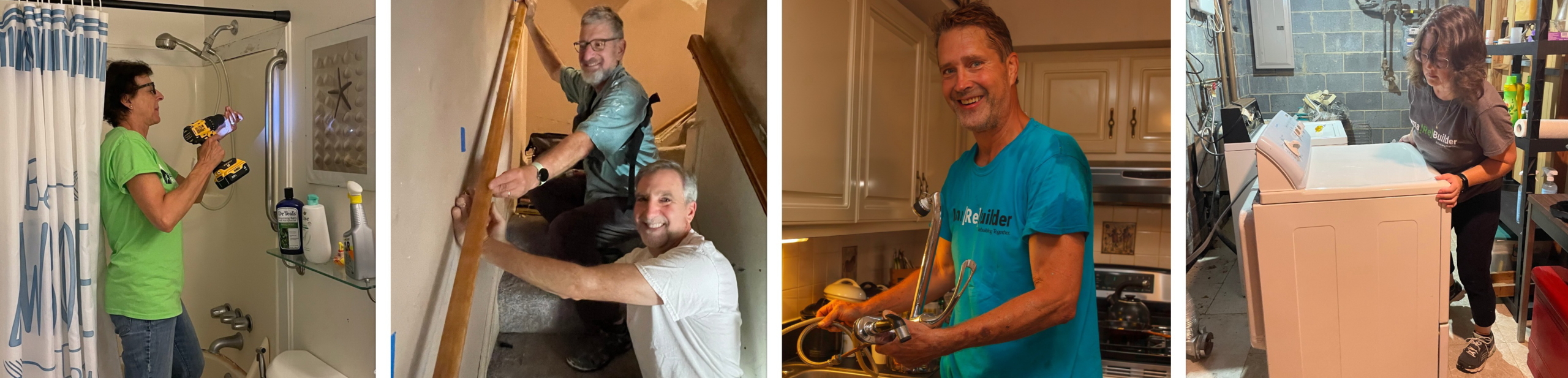
At Rebuilding Together Arlington/Fairfax/Falls Church (RT-AFF), our mission is simple but powerful: help neighbors live in safe, healthy homes. Through our 2025 contract with Fairfax County’s Department of Housing and Community Development, we provided critical home repairs and accessibility modifications that allow low-income homeowners—especially older adults and residents with disabilities—to remain safely in the homes they love.

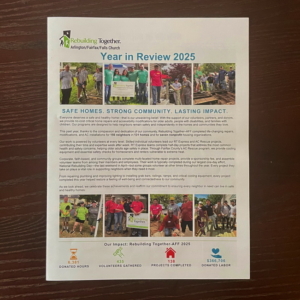
Our Year One Contract Report highlights the impact of this work across Fairfax County. In 2025, RT-AFF completed a total of 1,070 repairs for 113 low-income homeowners, addressing health and safety hazards and helping residents remain independent and secure in their homes.

The repairs completed ranged from relatively small but life-changing improvements—such as grab bars, improved lighting, and smoke alarms—to larger projects like wheelchair ramps, appliance replacements, and even roof and HVAC system replacements.

Each repair is part of a comprehensive assessment designed to improve safety, accessibility, and overall housing stability.

The homeowners served reflect the populations most vulnerable to housing-related risks. Many are older adults, people living with disabilities, and households with limited incomes who face barriers to maintaining their homes on their own.

By addressing safety hazards and accessibility needs, these repairs help residents remain in place and reduce the risk of injury, displacement, or housing instability.

This work is made possible through the dedication of volunteers, partners, and supporters who contribute thousands of hours and resources each year. Together, they help ensure that critical repairs reach those who need them most.

We invite you to explore the Year One Contract Report to learn more about the repairs completed, the households served, and the community partnerships that make this work possible.


Team Leader Profile – David Throckmorton

David sitting on the stairs during a stairlift installationAerospace Engineer Brings Skills Down to Earth 

Repairing homes isn’t rocket science, but Rebuilding Together-AFF Team Leader David Throckmorton has made good use of his aerospace career. 

Inspired by the Apollo moon missions while growing up in Richmond and Charlottesville, Va., David majored in aerospace engineering at Virginia Tech and later earned a master’s in systems engineering from Johns Hopkins.  

As a civilian employee of the U.S. Naval Air Systems Command and the Defense Department’s Missile Defense Agency, David worked on developing the F-35 and F-18 fighter jets and advanced GPS-guided bombs. As a systems integrator, he worked with defense contractors’ mechanical and electrical engineers to ensure that the jets, their weapons and other components worked smoothly together. 

Later as a program manager for the Homeland Security Science and Technology Directorate, he worked with contractors developing ground vibration sensors for border areas that could distinguish between human and animal footsteps. 

The experience managing complex projects has served David well since becoming an RT-AFF Team Leader in 2024. Team leaders do assessments of needed repairs at clients’ homes, prepare work plans, assemble needed supplies and tools, and supervise a team’s work. In 2025, David took on additional responsibilities assessing homes needing stairlifts, scheduling the work, and managing installations with Lou Wood, an RT-AFF volunteer who refurbishes donated stairlifts. 

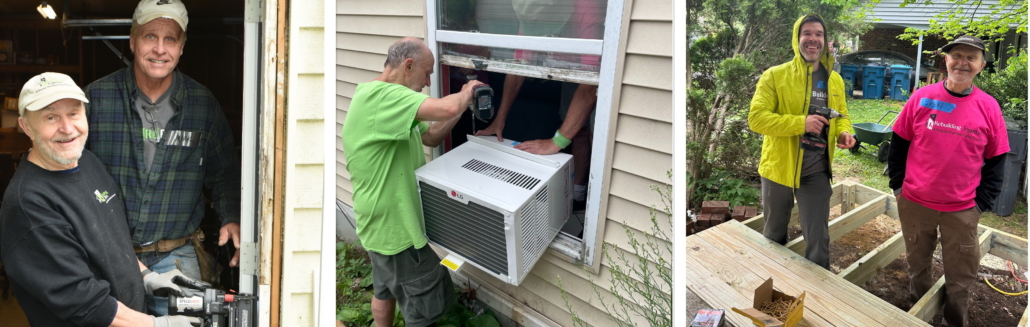
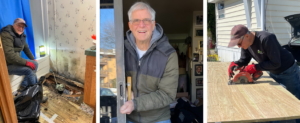
3 photos of David workingWide-ranging volunteering 

Since retiring in 2016, David has volunteered for a diverse variety of community services in addition to RT-AFF. 

“After retirement, I wanted to do things with my hands and things that challenged my brain,” he says. That desire led to serving four years on a backup call center for the national suicide hotline—staffing an early morning shift on Tuesdays—and one year with the Fairfax County domestic violence hotline. He also tutored students at the Fairfax County Adult High School. 

David has volunteered for eight years teaching computer skills for Northern Virginia Family Services Training Futures, which provides office skills and career training. And he helps his wife Debbie, who co-manages a food pantry at St. Matthew’s United Methodist Church in Annandale. 

David’s many volunteer activities earned him a 2024 Privilege Award for Outstanding Community Service from the Bernie L. Bates Foundation. The awards recognize Fairfax citizens who embody the values of the late Marion “Barney” Barnwell, a longtime RT-AFF board member and volunteer with many other Northern Virginia nonprofits  

Like many RT-AFF volunteers, David acquired do-it-yourself skills working on his home—an Alexandria, Va., condo where he remodeled the kitchen and bathroom. He first volunteered for the Alexandria Rebuilding Together chapter, then transferred to RT-AFF in 2021 when the Alexandria chapter paused operations during the Covid pandemic. 

What initially attracted David to Rebuilding Together was “doing hands-on stuff, but the other part of it was I get to do things for folks my parents’ age that I can’t do for them because they live 100 miles away.” 

Removing trip hazards on stairs, porches and decks are among the most useful repairs made for clients, he says. “It’s amazing to me how much a second handrail [on stairs] means to people. I’ve done it for my sister-in-law and parents. I recommend to anybody: Before you start thinking about moving, put in a second handrail.” Stairlifts are also impactful, especially in older Arlington homes where the bathroom is upstairs. 

What David finds most gratifying about volunteering for RT-AFF is “the homeowners’ thank-you’s at the end. The folks we help cannot really afford these improvements and are just so appreciative of everything we do. 

“It’s enjoyable just to be out with the team of people. You get to learn some stuff, and you get to help somebody.” 

three photos of David working

Links: 

Behind the Scenes with Lou Wood – RT-AFF Stair Lift Expert 

https://rebuildingtogether-aff.org/behind-the-scenes-with-lou-wood-rt-aff-stair-lift-expert/ 

Fairfax County Adult High School 

https://www.fcps.edu/academics/alternative-and-nontraditional-schools/fairfax-county-adult-high-school 

Northern Virginia Family Services Training Futures 

https://www.nvfs.org/assistance/training-futures 

St. Matthew’s Ken Jackson Food Closet 

https://www.stmatthewsumc.org/mission 

The 3rd Annual Privilege Awards and Community Recognition Celebration 

https://www.blbinc.org/post/the-3rd-annual-privilege-awards-and-community-recognition-celebration 


2025 Year in Review

As we begin 2026, we’re taking a moment to look back on the progress, partnerships, and people that shaped our work throughout 2025. Our 2025 Year in Review captures the milestones we reached together and the impact made possible through the collective efforts of our community. We’re proud to share this with you—stories and data that reflect not only what we accomplished, but why it matters as we move forward.


Team Leader Profile – Mark Heslep

Mark HeslepElectrical Engineer Completes the Circuit
Growing up in Richmond, Va., Mark Heslep learned building techniques working summers and weekends with his parents’ residential and commercial construction company.

Initially mostly shoveling or hauling plywood sheets up to a rooftop, “the work was back-breaking. But by late high school and college, I was picking up skills from some really good carpenter crews.”

Now retired after a career developing advanced electronics systems for military and aviation uses, Mark has come full circle—volunteering with us to support homeowners who need assistance maintaining their homes and aging in place.

Like his father—a civil engineering graduate of Virginia Military Institute—Mark attended VMI, majoring in electrical engineering. He then earned a master’s in electrical engineering at the University of Virginia in 1985.

Moving to Dallas, he worked for LTV Corp., integrating aerial photography for realistic flight simulators for military pilots, among other projects. When the huge conglomerate struggled financially during an economic downturn in the mid-1980s, Mark moved to Northern Virginia, ultimately joining a friend’s startup company developing radar equipment and technology. “We were constantly solving really hard problems that had to be done fast. I got a big kick out of doing that and learned a tremendous amount,“ he says.

In 1996, he moved to the MITRE Corp., “once again putting electronics into military vehicles” that endure harsh environments, including amphibious tanks for the U.S. Marine Corps. In 2003, he met his wife Catherine. Their oldest son is now studying engineering at Virginia Tech, while another son and daughter are in high school.

Racing on Land and Water

While at MITRE, Mark participated in a competition sponsored by the U.S. Defense

Advanced Research Projects Agency to stimulate research and development of self-driving vehicles. The 2005 DARPA Grand Challenge was a driverless race over a rugged off-road course in California’s Mojave Desert. MITRE’s entry, a pickup truck named Meteor, excelled in preliminary rounds but failed in the final round when dust and debris blew across the course and the truck’s laser sensors could not discern the way to go.

Racing robots isn’t the only type of racing Mark has done. After moving to NoVa, a roommate who had been on the U.S. Olympic rowing team introduced him to that sport. “Right away it piqued my interest and I took some classes and wanted to go further.”

In 1994, a Russian émigré who had been a championship rower and coach of the Soviet Olympic team became a coach at the Capital Rowing Club in Washington, D.C., and began more intensive year-round training for members. The club’s teams steadily improved and started winning medals at national and international competitions. In 2001, Mark’s team won the age 40 and over flight at the FISA World Masters Regatta in Montreal. Mark continues to work out several mornings a week at the club’s D.C. boathouse along the Anacostia River.

After retiring in 2013, Mark first started volunteering with RT-AFF on a National Rebuilding Day team organized by his church. He was later invited to become an RT Express Team Leader when the staff learned about extensive energy-saving improvements he had made to his home. Team leaders do assessments of needed repairs at clients’ homes, prepare work plans, assemble needed supplies and tools, and supervise a team’s work.

Mark advises potential volunteers to “think about what your skills are and then offer them up to your team leader so we can put you on that kind of task. But be adaptable to whatever the leader needs you to do.”

He loves that “you get people with a lot of skills and you orchestrate them with a good plan. And you can accomplish a tremendous amount in five or six hours.

“It’s hard to give money or do charity work where I think you can be sure that you’re really making an impact. But you can clearly see what RT-AFF does is worthwhile and it’s really helping people.”

Links:

2005 DARPA Grand Challenge

https://en.wikipedia.org/wiki/DARPA_Grand_Challenge_(2005)

MITRE Sponsors Team for the DARPA Grand Challenge ’05

https://web.archive.org/web/20070815133723/http:/www.mitre.org/tech/meteor/

Capital Rowing Club

https://capitalrowing.org/

2001 FISA World Masters Regatta

2001 FISA World Masters Regatta is Honoured in Quebec – World Rowing

Team Leader Profile – Ken Mittelholtz

Ken Mittelholtz

Ken Mittelholtz

Public Service Is Deeply Ingrained in Ken Mittelholtz

Commitment to public service is deep-rooted in Ken Mittelholtz. The long-time Rebuilding Together team leader has put his altruism to work as a teacher, a two-time Peace Corps volunteer, and a federal employee for the U.S. Coast Guard and Environmental Protection Agency.

Ken credits much of his public spirit to his parents. His father worked in education and management roles for the Bureau of Indian Affairs while raising Ken and his brother in New Mexico, Minnesota, Wisconsin and North Dakota. “My dad was by far the biggest one that influenced me in terms of helping others. And that probably got me also heavily involved in public service.”

After graduating from Bemidji State University in Minnesota in 1967 with a degree in chemistry, Ken taught science in high school for several years. He joined the Peace Corps in the early 1970s, teaching science in junior and secondary schools in the Republic of The Gambia, an English-speaking former British colony.

Ken then taught science in a private school in Maryland for four years before returning to The Gambia for another two years with the Peace Corps, this time working in the attorney general’s office on environmental legislation to protect wildlife.

It takes a village

The Peace Corps left a deep impression on Ken. “You learn more about them than they do about you. You’re enmeshed in the culture and you really do learn the issues that they’re facing,” he says. “Anybody who has come back from the Peace Corps gets involved with service stuff back here.”

Ken notes that “everybody wants to be part of a village [and] have people come and help you. But to be part of a village, you also need to be a villager. You need to do things.”

The Peace Corps was followed by an environmental job with the Coast Guard, issuing permits for bridges. In 1984 he moved to the EPA, doing environmental reviews of roads, airports, military and other federal construction projects until retiring in 2010.

When he worked for the government, people would often tell Ken he could earn more as a consultant. But he always felt that “it’s important for us to do these types of things. The public service has always been kind of important to me.”

In the 1980s Ken began volunteering with Annandale Christian Community for Action, a group of 21 churches in the Annandale area. ACCA sponsors a variety of food pantry, daycare, furniture donation, financial aid, transportation and other programs for Northern Virginia families, as well as partnering with Rebuilding Together.

Ken’s wife Camille and their two daughters are also longtime volunteers with ACCA. Both have served as presidents, and the couple was honored with the Volunteer Fairfax Community Champion award in 2013.

Ken Mittelholtz collage

Helping people age in place

Unlike some Rebuilding Together team leaders with engineering and construction backgrounds, Ken’s do-it-yourself skills are mostly self-taught from working on his previous and current homes.

His first project was in 1994 when ACCA sponsored teams to repair two houses on National Rebuilding Day for the nonprofit, then called Christmas in April. He has continued every year since, stepping up his involvement when the organization began repairing homes year-round.

He lauds the nonprofit as ”a very neat program of helping people stay in their homes. As we get older now, it rings true a little bit more of trying to stay in your home for a longer period of time.”

Many elderly clients, he notes, are “house rich and money poor. They’re living on Social Security and don’t have enough money to do any of the maintenance” and are unable to do repairs themselves.

He cites installing grab bars in bathrooms and adding a second handrail to stairways as among the most useful improvements commonly made. He believes grab bars could eventually be required by building codes because “you don’t have to be old to slip in the tub and fall.”

Ken enjoys the camaraderie of working with other volunteers “as we all have this kind of commitment of helping people” to stay in and enjoy their homes.

He tells potential volunteers: “You’ll get a big benefit from it. I think you’ll feel good. It’s a neat feeling of helping people out.”

Links:

County Residents Ken and Camille Mittelholtz Named Community Champions

https://patch.com/virginia/annandale/an–county-residents-ken-and-camille-mittelholtz-nameb0521a1c1e

Annandale Christian Community Action Service Programs

https://accacares.org/service-programs

Ken Mittelholtz collage

Volunteer Profiles are a continuing series celebrating the dedicated Rebuilding Together Team Leaders and volunteers, who come from all walks of life—engineering, construction, government, diplomacy, the military, and more.

The profiles are written by Leon Rubis, a retired journalist and editor who started volunteering with us in 2021. A long-time DIYer, Leon says, “I thought I knew a lot, but I’ve learned so much more from working alongside our experienced teams. Every project feels like an episode of This Old House.”

In addition to making repairs and modifications with us as part of the RT Express program, Leon is now using his writing skills to spotlight the amazing people who make our work possible.

Team Leader Profile – Bard Jackson

Working with Electricity from a Big-Picture Perspectivephoto of Bard Jackson

Rebuilding Together Team Leader Bard Jackson doesn’t just know how to install an electrical fixture—he can electrify an entire region.

For more than 30 years of his career before retiring in 2014, Bard worked for the U.S. Rural Electrification Administration and National Rural Electric Cooperative Association. At the REA (later renamed the Rural Utilities Association), he worked with electric cooperatives to plan, fund and inspect their distribution lines, including land acquisition and eminent domain proceedings.

At the NRECA, he did similar work in Africa and Latin America, doing feasibility studies and cost analyses for Third World countries needing electricity. Bard’s most memorable projects were developing small hydroelectric plants that brought power to rural areas of Costa Rica and Zaire, (now the Republic of Congo), where remote villagers had only portable generators to power refrigerators and small businesses.

After graduating with an electrical engineering degree from Long Beach State University in 1969, Bard’s first experience developing electrical grids came with the Peace Corps in Brazil, where he worked on electric cooperatives to supply power to rural areas.

Bard then joined the U.S. Navy for four years, first working on its nuclear power program and later serving as the electrical engineering officer on the USS Sanctuary, a World War II hospital ship that was undergoing extensive renovations for stationing in Greece. The Navy cancelled that plan, but not before Bard met his wife Susan, a nurse who was also serving on the ship.

After Navy service, Bard attended graduate school at Georgia Tech before starting his career of developing electric utilities.

Learning by doing

Growing up in the Los Angeles area, Bard acquired handyman skills at an early age. His father, a chemical engineer, “never paid anybody to do anything at our house; he did it all.”

The family had a small ranch in the Sierra Mountains. “We had a few head of cattle on it. When you’re a rancher/famer, you do everything,” he said. In summers during high school, Bard helped build a future retirement home there for his parents. More recently, he did repairs and maintenance on a couple rental properties he previously owned in Northern Virginia. His advice for do-it-yourselfers: Look at YouTube, then “do it right the first time—that’s the fastest way to do a job!”

Bard stays active with sports, volunteer work and visiting his two children and five grandchildren in Connecticut and California. In 2013, he played on an over-65 team that competed in the National Volleyball Association’s open national tournament in the Chesapeake Region. He now plays pickup soccer with friends who call themselves the ROMEOs—retired old men enjoying outdoor soccer.

His other volunteer work includes salvaging and nurturing landscaping plants at his home for the Falls Church Garden Club’s annual plant sale fundraiser. Owners of homes that are being torn down offer landscaping plants to the club. Bard digs up the plants, replants some at his home and keeps some in pots until transporting them to the spring sale site.

Bard started volunteering for RT-AFF’s predecessor, Christmas in April, through his church’s volunteer team. In 2015, he became a regular volunteer and team leader as the nonprofit expanded its services to year-round projects. In 2017, he won the Senior Volunteer award from Volunteer Fairfax. Today, Bard usually volunteers one day a week and serves as team leader for one project a month. Team leaders do initial assessments of clients’ homes, prepare work plans, assemble needed supplies and tools, and supervise the team’s work.

Bard enjoys that “every project is different—I learn something. It keeps me active and going to new places.” He encourages would-be volunteers for Rebuilding Together to “give it a try—see if it’s for you.”


Links:

USS Sanctuary

https://en.wikipedia.org/wiki/USS_Sanctuary

Falls Church Garden Club

https://www.fallschurchgardenclub.org/

Fairfax celebrates spirit of volunteerism at awards ceremony

https://www.insidenova.com/headlines/fairfax-celebrates-spirit-of-volunteerism-at-awards-ceremony/article_be4fb322-29a0-11e7-a5a4-375545225e4d.html#google_vignette

Volunteer Profiles are a continuing series celebrating the dedicated Rebuilding Together Team Leaders and volunteers, who come from all walks of life—engineering, construction, government, diplomacy, the military, and more.

The profiles are written by Leon Rubis, a retired journalist and editor who started volunteering with us in 2021. A long-time DIYer, Leon says, “I thought I knew a lot, but I’ve learned so much more from working alongside our experienced teams. Every project feels like an episode of This Old House.”

In addition to making repairs and modifications with us as part of the RT Express program, Leon is now using his writing skills to spotlight the amazing people who make our work possible.


Bill Marshall’s Impact at Rebuilding Together AFF

After retiring from a successful home-building career, Bill Marshall was eager for a new way to channel his energy and expertise. He found the perfect fit with Rebuilding Together Arlington/Fairfax/Falls Church (RT-AFF) through Volunteer Arlington and quickly became a dedicated member of our Rebuilding Together Express (RT Express) program. Bill’s extensive background in construction and business management made an immediate difference and he became an active member of our Board of Directors as well as Chair of the Program Committee. During his six-year tenure on the Board, he played a vital role in shaping RT-AFF’s repair and modification initiatives.

“Bill was instrumental in leading RT-AFF’s repair program through the pandemic,” said Executive Director Patti Klein. “He worked in partnership with staff to develop a solid plan to implement COVID safety protocols, allowing a small group of our most experienced RT Express volunteers to continue making critical home repairs for those in need.”

Beyond his leadership on the board, Bill has worked on more than 120 homes, improving the lives of countless neighbors. He has also designed and led teams in building more than 15 wheelchair ramps—one of the most transformative modifications for homeowners with mobility challenges.

Bill was especially touched by a project he led in Arlington, where a team of volunteers modified a bathroom in a small home to make it fully accessible for twins with disabilities. This transformation gave them the independence to use the bathroom on their own as they grew into their teen years.

Reflecting on his service, Bill shared, “I am grateful for my time on the RT-AFF board. My experience running my own construction business and serving on other boards allowed me to contribute meaningfully. The Jesuits in high school instilled in me the belief that we should be ‘men (and women) for others,’ and I’m proud to uphold that value with this incredible organization.”

Though stepping down from the board, Bill remains deeply committed to RT-AFF’s mission. As an RT Express team leader, he’s continuing to roll up his sleeves to help homeowners in need. “It’s amazing what a small group of volunteers can accomplish in just a few hours with a few hundred dollars in materials,” he said. “I’m constantly impressed by the impact we make, the camaraderie we share, and the dedication of everyone involved.”

We are incredibly grateful for Bill’s leadership and ongoing contributions. His work continues to make a lasting difference, and we look forward to seeing him in action with our RT Express program for years to come.


Celebrating our 500th Rebuilding Together Express Project

Volunteers with homeowner on stepsRebuilding Together-AFF recently celebrated the completion of its 500th RT Express project, a significant milestone for a program that now makes up two-thirds of our total work. The steady need for repairs within our standard RT Express service list has not only allowed us to assist more homeowners but has also helped us build a dedicated base of individual volunteers. These volunteers contribute regularly and continually hone their skills, becoming highly proficient in delivering our most common repairs.

In 2014, we faced a pressing challenge: many homeowners in need of minor repairs and safety modifications couldn’t wait months for National Rebuilding Day or for a match with a corporate team. Recognizing the urgency, we used seed funding from The Falls Church Episcopal to develop a faster, more efficient solution. With additional support from the Northern Virginia Health Foundation, we defined, tested, and refined what became Rebuilding Together Express (RT Express)—a program designed to deliver essential health and safety repairs and accessibility modifications for people with disabilities and older people who want to age in place.

How RT Express Works:

Small teams of 4-5 volunteers dedicate 4-5 hours and about $400-$500 in materials to provide a range of approximately 40 common home modifications and repairs. These repairs are tailored to each homeowner’s needs and based on a thorough assessment of the home. RT Express enables Rebuilding Together-AFF to respond more quickly to homeowners facing urgent risks, such as falls or other safety concerns.

The Key to Success: Volunteer Team Leaders

Our volunteer team leaders are the cornerstone of RT Express. They:

  • Conduct home assessments with staff.
  • Develop realistic scopes of work.
  • Purchase materials and assemble tools.
  • Coordinate repairs while ensuring safety for both homeowners and volunteers.
  • Track project outcomes.

After years of relying on six dedicated team leaders, we expanded their ranks to 10 in early 2024, ensuring we can meet growing demand. Our Team Leaders are pictured above.

Recognition and Growth:

In 2018, RT-AFF earned the Commonwealth Council on Aging’s top statewide Best Practices Award for RT Express. Since then, we’ve expanded the program to include additional services such as installing stairlifts and building wheelchair ramps.

Our volunteers describe RT Express projects as deeply fulfilling, while the homeowners we serve express their gratitude with heartfelt hugs and words of appreciation.

Multi-year sponsorships by West Financial Services and Sandy Spring Bank have sustained RT Express and supported its steady growth.