Team Leader Profile – Ken Mittelholtz

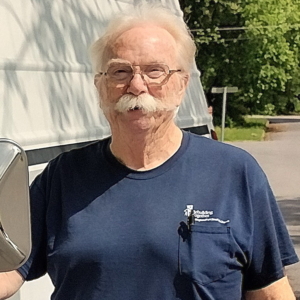
Ken Mittelholtz

Ken Mittelholtz

Public Service Is Deeply Ingrained in Ken Mittelholtz

Commitment to public service is deep-rooted in Ken Mittelholtz. The long-time Rebuilding Together team leader has put his altruism to work as a teacher, a two-time Peace Corps volunteer, and a federal employee for the U.S. Coast Guard and Environmental Protection Agency.

Ken credits much of his public spirit to his parents. His father worked in education and management roles for the Bureau of Indian Affairs while raising Ken and his brother in New Mexico, Minnesota, Wisconsin and North Dakota. “My dad was by far the biggest one that influenced me in terms of helping others. And that probably got me also heavily involved in public service.”

After graduating from Bemidji State University in Minnesota in 1967 with a degree in chemistry, Ken taught science in high school for several years. He joined the Peace Corps in the early 1970s, teaching science in junior and secondary schools in the Republic of The Gambia, an English-speaking former British colony.

Ken then taught science in a private school in Maryland for four years before returning to The Gambia for another two years with the Peace Corps, this time working in the attorney general’s office on environmental legislation to protect wildlife.

It takes a village

The Peace Corps left a deep impression on Ken. “You learn more about them than they do about you. You’re enmeshed in the culture and you really do learn the issues that they’re facing,” he says. “Anybody who has come back from the Peace Corps gets involved with service stuff back here.”

Ken notes that “everybody wants to be part of a village [and] have people come and help you. But to be part of a village, you also need to be a villager. You need to do things.”

The Peace Corps was followed by an environmental job with the Coast Guard, issuing permits for bridges. In 1984 he moved to the EPA, doing environmental reviews of roads, airports, military and other federal construction projects until retiring in 2010.

When he worked for the government, people would often tell Ken he could earn more as a consultant. But he always felt that “it’s important for us to do these types of things. The public service has always been kind of important to me.”

In the 1980s Ken began volunteering with Annandale Christian Community for Action, a group of 21 churches in the Annandale area. ACCA sponsors a variety of food pantry, daycare, furniture donation, financial aid, transportation and other programs for Northern Virginia families, as well as partnering with Rebuilding Together.

Ken’s wife Camille and their two daughters are also longtime volunteers with ACCA. Both have served as presidents, and the couple was honored with the Volunteer Fairfax Community Champion award in 2013.

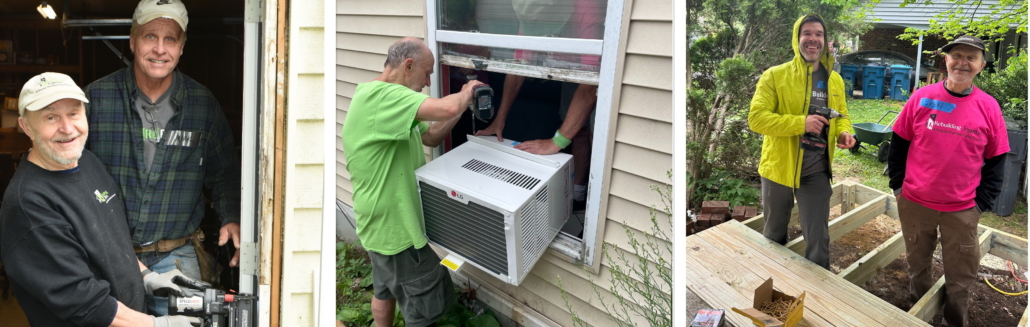
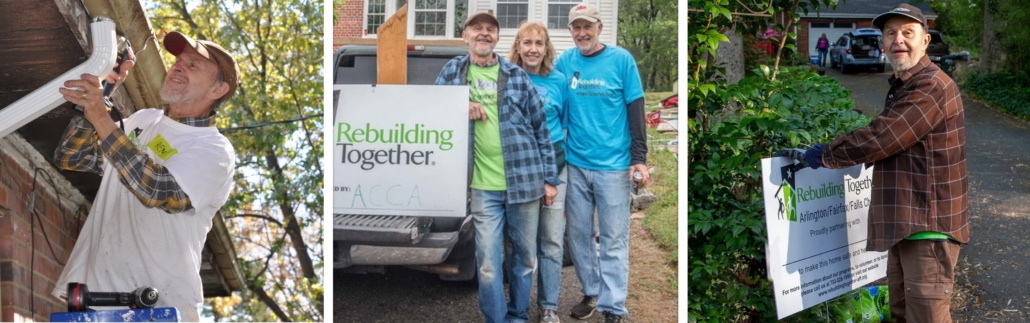
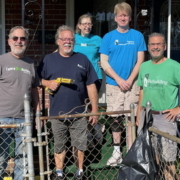
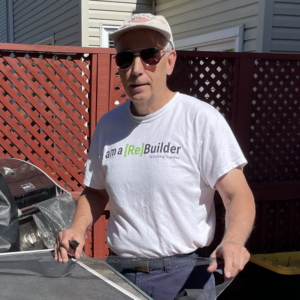
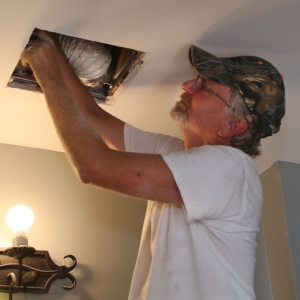
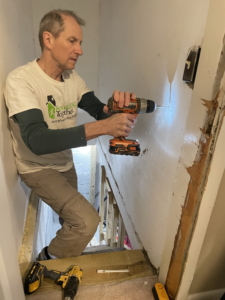
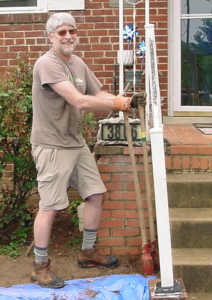
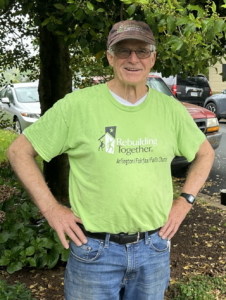
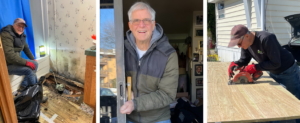
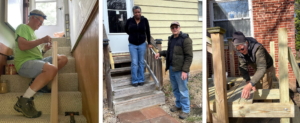
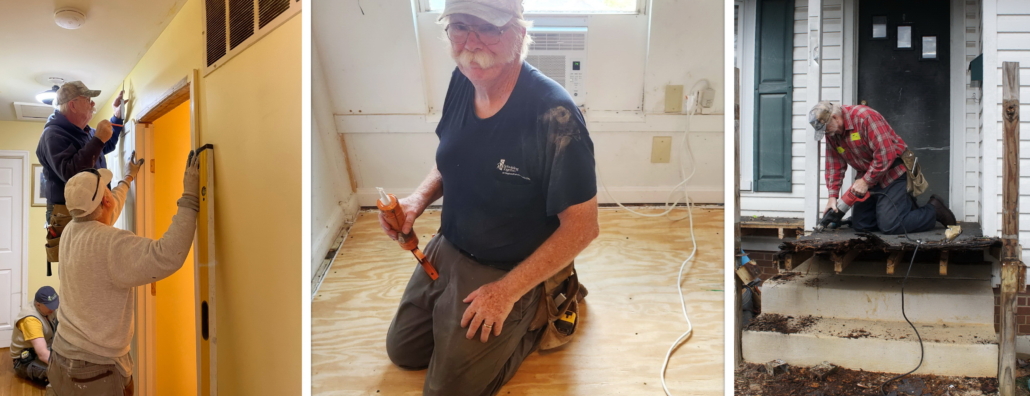
Ken Mittelholtz collage

Helping people age in place

Unlike some Rebuilding Together team leaders with engineering and construction backgrounds, Ken’s do-it-yourself skills are mostly self-taught from working on his previous and current homes.

His first project was in 1994 when ACCA sponsored teams to repair two houses on National Rebuilding Day for the nonprofit, then called Christmas in April. He has continued every year since, stepping up his involvement when the organization began repairing homes year-round.

He lauds the nonprofit as ”a very neat program of helping people stay in their homes. As we get older now, it rings true a little bit more of trying to stay in your home for a longer period of time.”

Many elderly clients, he notes, are “house rich and money poor. They’re living on Social Security and don’t have enough money to do any of the maintenance” and are unable to do repairs themselves.

He cites installing grab bars in bathrooms and adding a second handrail to stairways as among the most useful improvements commonly made. He believes grab bars could eventually be required by building codes because “you don’t have to be old to slip in the tub and fall.”

Ken enjoys the camaraderie of working with other volunteers “as we all have this kind of commitment of helping people” to stay in and enjoy their homes.

He tells potential volunteers: “You’ll get a big benefit from it. I think you’ll feel good. It’s a neat feeling of helping people out.”

Links:

County Residents Ken and Camille Mittelholtz Named Community Champions

https://patch.com/virginia/annandale/an–county-residents-ken-and-camille-mittelholtz-nameb0521a1c1e

Annandale Christian Community Action Service Programs

https://accacares.org/service-programs

Ken Mittelholtz collage

Volunteer Profiles are a continuing series celebrating the dedicated Rebuilding Together Team Leaders and volunteers, who come from all walks of life—engineering, construction, government, diplomacy, the military, and more.

The profiles are written by Leon Rubis, a retired journalist and editor who started volunteering with us in 2021. A long-time DIYer, Leon says, “I thought I knew a lot, but I’ve learned so much more from working alongside our experienced teams. Every project feels like an episode of This Old House.”
In addition to making repairs and modifications with us as part of the RT Express program, Leon is now using his writing skills to spotlight the amazing people who make our work possible.

Doers Profiles – Meet Some of our Dedicated Volunteers

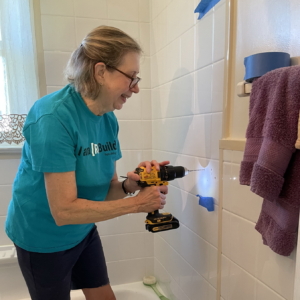
Leon RubisOur volunteer profiles are written by Leon Rubis (pictured at right), a retired journalist and editor who started volunteering with us in 2021. A long-time DIYer, Leon says, “I thought I knew a lot, but I’ve learned so much more from working alongside our experienced teams. Every project feels like an episode of This Old House.”

In addition to making repairs and modifications with us as part of the RT Express program, Leon is now using his writing skills to spotlight the amazing people who make our work possible.

Leon coined the name “Doers Profiles” as a playful nod to the iconic Dewar’s Profiles ads of the 1980’s. We’ll be highlighting our volunteers by sharing their answers to a curated list of 14 questions—ranging from favorite learning moments to biggest blunder on a personal project as well as their hobbies or other volunteer work. Leon gathers these insights to help us get to know the dedicated individuals who make our mission possible.


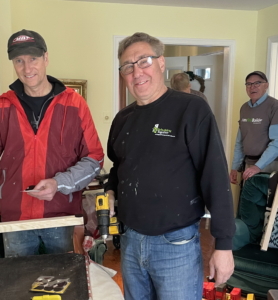
three volunteers working on a project

Scott Campbell (c) with Kevin (l) and Gordon (r)

Scott Campbell

Career: Retired Army officer and diplomat. Field artillery for 10 years, then development and testing of cannon systems for 18 years. Lots of fun to blow stuff up!

How I learned about home repair: As a teenager I helped my dad convert row homes into apartments, so I learned basic carpentry, electrical and plumbing from him.

Most significant home project: I added a 2,000-square-foot deck at the back of my house.

Biggest blunder on my own project: Not securing a ladder. I once fell one floor when my ladder slipped. Got knocked out and a concussion.

Other volunteer work: Volunteer ski patroller and instructor 1991-2019. I still teach avalanche rescue training for the Ski Patrol, and serve on boards of autism non-profits.


Patricia Hupalo

Career: College administrator at George Mason University.

Other volunteer work: Services for senior citizens at Arlington Neighborhood Village and garden maintenance and harvesting for Arlington Food Assistance Center.

Tips for do-it-yourselfers: Have the right tool. Be patient as jobs always take longer than you expect. Use online tutorials.

Advice for would-be RT-AFF volunteers: Volunteering can be whenever your schedule permits. It’s a great way to pick up new skills and work with some great people.


Chris Loda

Career: Retired union electrician with master’s license. Was part owner of a small electrical contracting business.

Personal highlights: Raising a family and putting all four children through college debt-free.

Most significant home project: I put a second story on my house. The most challenging part was installing stair railings.

Most impactful RT-AFF job: Enlarging a bathroom for two children using wheelchairs. We made a great impact on their lives.


Kevin Bruestle


Kevin Bruestle

Career: Satellite communications engineer.

Personal highlights: I biked across America and earned a black belt in Tae Kwon Do.

Most significant home project: Building a screened-in porch with skylights, ceiling fan and music speakers.

Other volunteer work: I volunteer at the National Air and Space Museum’s Astronomy Department.


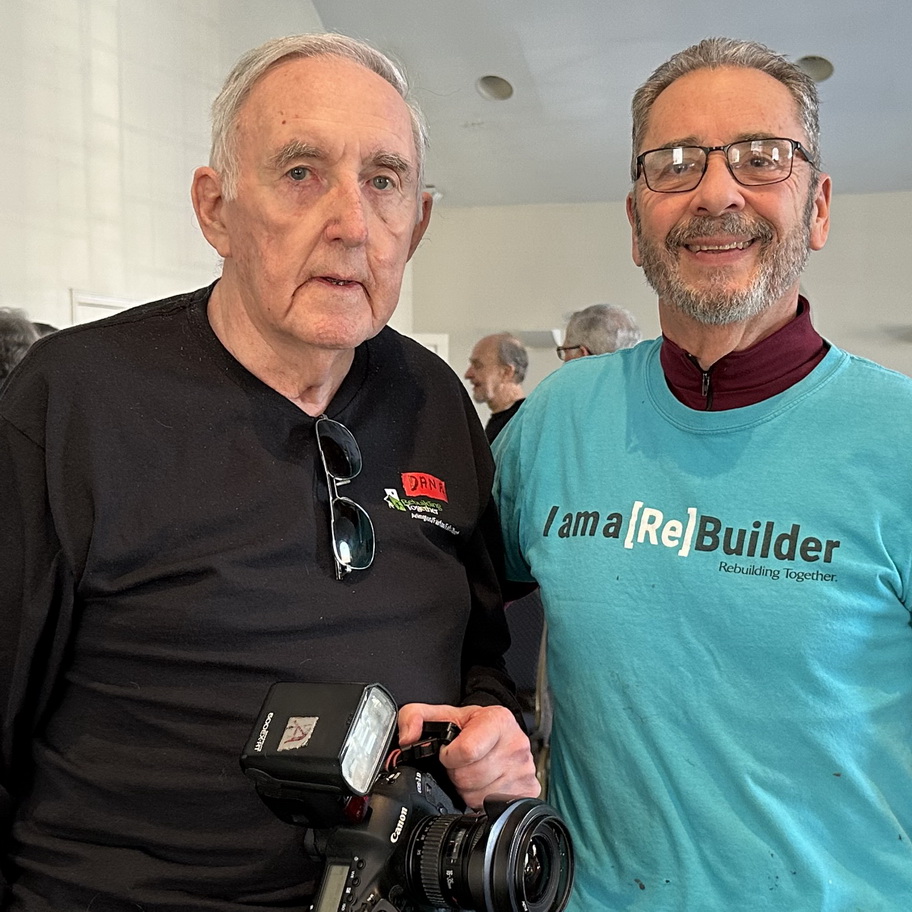
Dan Feighery (l) with Don Ryan.

Dan Feighery (l) with Don Ryan.

Dan Feighery

Career: U.S. Air Force officer 1961-88. As a B-52 bomber pilot, completed about 400 combat missions over Vietnam. I was also a flight instructor and director for Strategic Air Command’s flight training.

Favorite tool: I’m a volunteer photographer for RT-AFF. My only tool is my Canon 1Dx camera.

Other volunteer work: I taught photography at the Lifelong Learning Institute at George Mason University. In September 2025, I’ll be the official photographer for some events in the Senior Olympics.


John Maher

John Maher

Career: U.S. Foreign Service Officer for 32 years. I served in Japan, China, Korea, Taiwan, Armenia and Washington, D.C. I learned Chinese and Japanese, as well as some Korean and Armenian.

Repair skill most proud of learning: Installing grab bars on tiled showers so I could do it for my parents.

Biggest blunder on a personal project: Almost cutting off an index finger with an electric hedge trimmer. A hand surgeon was able to save the finger.

Most impactful RT-AFF job: Installing air conditioners for low-income residents in metal trailers during a heat wave.


Team Leader Profile – Bard Jackson

Working with Electricity from a Big-Picture Perspectivephoto of Bard Jackson

Rebuilding Together Team Leader Bard Jackson doesn’t just know how to install an electrical fixture—he can electrify an entire region.

For more than 30 years of his career before retiring in 2014, Bard worked for the U.S. Rural Electrification Administration and National Rural Electric Cooperative Association. At the REA (later renamed the Rural Utilities Association), he worked with electric cooperatives to plan, fund and inspect their distribution lines, including land acquisition and eminent domain proceedings.

At the NRECA, he did similar work in Africa and Latin America, doing feasibility studies and cost analyses for Third World countries needing electricity. Bard’s most memorable projects were developing small hydroelectric plants that brought power to rural areas of Costa Rica and Zaire, (now the Republic of Congo), where remote villagers had only portable generators to power refrigerators and small businesses.

After graduating with an electrical engineering degree from Long Beach State University in 1969, Bard’s first experience developing electrical grids came with the Peace Corps in Brazil, where he worked on electric cooperatives to supply power to rural areas.

Bard then joined the U.S. Navy for four years, first working on its nuclear power program and later serving as the electrical engineering officer on the USS Sanctuary, a World War II hospital ship that was undergoing extensive renovations for stationing in Greece. The Navy cancelled that plan, but not before Bard met his wife Susan, a nurse who was also serving on the ship.

After Navy service, Bard attended graduate school at Georgia Tech before starting his career of developing electric utilities.

Learning by doing

Growing up in the Los Angeles area, Bard acquired handyman skills at an early age. His father, a chemical engineer, “never paid anybody to do anything at our house; he did it all.”

The family had a small ranch in the Sierra Mountains. “We had a few head of cattle on it. When you’re a rancher/famer, you do everything,” he said. In summers during high school, Bard helped build a future retirement home there for his parents. More recently, he did repairs and maintenance on a couple rental properties he previously owned in Northern Virginia. His advice for do-it-yourselfers: Look at YouTube, then “do it right the first time—that’s the fastest way to do a job!”

Bard stays active with sports, volunteer work and visiting his two children and five grandchildren in Connecticut and California. In 2013, he played on an over-65 team that competed in the National Volleyball Association’s open national tournament in the Chesapeake Region. He now plays pickup soccer with friends who call themselves the ROMEOs—retired old men enjoying outdoor soccer.

His other volunteer work includes salvaging and nurturing landscaping plants at his home for the Falls Church Garden Club’s annual plant sale fundraiser. Owners of homes that are being torn down offer landscaping plants to the club. Bard digs up the plants, replants some at his home and keeps some in pots until transporting them to the spring sale site.

Bard started volunteering for RT-AFF’s predecessor, Christmas in April, through his church’s volunteer team. In 2015, he became a regular volunteer and team leader as the nonprofit expanded its services to year-round projects. In 2017, he won the Senior Volunteer award from Volunteer Fairfax. Today, Bard usually volunteers one day a week and serves as team leader for one project a month. Team leaders do initial assessments of clients’ homes, prepare work plans, assemble needed supplies and tools, and supervise the team’s work.

Bard enjoys that “every project is different—I learn something. It keeps me active and going to new places.” He encourages would-be volunteers for Rebuilding Together to “give it a try—see if it’s for you.”


Links:

USS Sanctuary

https://en.wikipedia.org/wiki/USS_Sanctuary

Falls Church Garden Club

https://www.fallschurchgardenclub.org/

Fairfax celebrates spirit of volunteerism at awards ceremony

https://www.insidenova.com/headlines/fairfax-celebrates-spirit-of-volunteerism-at-awards-ceremony/article_be4fb322-29a0-11e7-a5a4-375545225e4d.html#google_vignette

Volunteer Profiles are a continuing series celebrating the dedicated Rebuilding Together Team Leaders and volunteers, who come from all walks of life—engineering, construction, government, diplomacy, the military, and more.

The profiles are written by Leon Rubis, a retired journalist and editor who started volunteering with us in 2021. A long-time DIYer, Leon says, “I thought I knew a lot, but I’ve learned so much more from working alongside our experienced teams. Every project feels like an episode of This Old House.”

In addition to making repairs and modifications with us as part of the RT Express program, Leon is now using his writing skills to spotlight the amazing people who make our work possible.


Team Leader and Volunteer Profiles

Leon RubisWelcome to our new series celebrating the dedicated Rebuilding Together Team Leaders and volunteers, who come from all walks of life—engineering, construction, government, diplomacy, the military, and more.

The profiles are written by Leon Rubis (pictured at right), a retired journalist and editor who started volunteering with us in 2021. A long-time DIYer, Leon says, “I thought I knew a lot, but I’ve learned so much more from working alongside our experienced teams. Every project feels like an episode of This Old House.”

In addition to making repairs and modifications with us as part of the RT Express program, Leon is now using his writing skills to spotlight the amazing people who make our work possible.

Team Leader Profile – Jim Dillon

Jim Applies Do-it-Yourself Skills to VolunteeringJim Dillon

When people need help, Jim Dillon doesn’t wait for nonprofit agencies to organize a response. The long-time Rebuilding Together volunteer often jumps in on his own.

After Hurricane Katrina slammed the Gulf Coast in 2005, Jim leaped into action—ultimately making six trips to Mississippi and New Orleans to repair damaged homes.

He first helped a family friend in Bay St. Louis, Miss., whose two brothers’ low-lying homes were flooded. Jim and a friend stayed for three weeks in another damaged house owned by a sister while repairing it and other homes.

That led to volunteering for a small Catholic church in New Orleans’ Ninth Ward. Many of the parishioners had left their flooded homes, leading the pastor to fund home repairs and recruit volunteer workers “just so we can bring people back to his parish.” Jim and other volunteers stayed on the second floor of the church school. “They found houses for you to work on during the day, and just gave you an address, [saying] go on over and help these folks as best you can.”

Collage of three photos of Jim Dillon volunteering his time.

All in the family

Jim, raised in Hamburg, N.Y., perhaps inherited some mechanical talent along with a desire to help others. His father was a civil engineer and two older brothers also became civil and mechanical engineers. A sister became a missionary with the Maryknoll nuns and has “traveled all over the world doing all kinds of good things for all kinds of different folks.”

Jim graduated from the University of Buffalo in 1971 with a mechanical engineering degree. He moved to Northern Virginia for a civilian job with a U.S. Army research and development center at Fort Belvoir until retiring in 2003.

Jim initially wrote specifications for construction equipment the Army purchased, and later designed vehicles and systems that could clear land mines. Other work involved retrofitting vehicles like Humvees and cargo trucks with mine blast protection such as deflectors, seats that absorb blast impacts, fragment-resistant floor mats, and extra seat restraints.

Despite his independent self-starter streak, Jim has volunteered with a variety of nonprofit service organizations.

He started working for Rebuilding Together’s predecessor, Christmas in April, after seeing a television news report about one of its local repair projects in 1994 and thinking “Wow, that’s pretty cool. I’d like to do that.”

In 1996, Jim also started working with the Catholic Diocese of Arlington’s Work Camp summer program, in which high-school-age parishioners stay for a week at a school in Virginia while working on repairs for local homeowners referred by local governments, churches and word-of-mouth.

“We started working on maybe a couple of dozen houses during the mid ‘90s. And over the years that has grown to maybe 800 kids working on over 100 homes for four days.”

The teens are accompanied by adult chaperones and “contractors” like Jim who provide technical training and supervision to the work crews. “I hand them all the tools and show them how to do it. And then I watch them for a while and if they feel comfortable with it—go for it.”

A Travellin’ Van

Even with Work Camp, Jim has independently extended his efforts beyond the organized summer program.

He and others visit and evaluate houses in the fall to work on next June. But “when you go into a house and see that the hot water heater’s leaking or the furnace doesn’t work, well, you can’t just tell the family, ‘I’ll be back in six months to help you’—they need it right now. So [with] a few friends of mine that I met at Rebuilding Together, we volunteered our time to go out and do some of these projects ahead of time.

“And then, like with Rebuilding Together, once you get into these projects and sometimes you can’t finish them during the day, you may have to go back a time or two after that. And that was the same thing with summer camp with the high school kids. You got to go back the next week or the next month and try to finish off all the projects.”

Such dedication prompted Jim to buy himself a retirement gift in 2004—a 2003 Chevrolet van that serves as a traveling hardware store. “I learned from summer camp that when you work far away from the local hardware store, you try to bring as much of the stuff as you can.” Jim’s wife Joan, who was supportive of his sometimes lengthy volunteer trips, first saw the van for sale and encouraged him to buy it.

One of Jim’s most challenging projects with Rebuilding Together was a small condemned house it renovated in 2017 in Fairfax City. Foundation leaks from rain and plumbing led to termite infestations and structural deterioration making the house uninhabitable. Rebuilding Together volunteers worked more than 2,400 hours on the house—1,000 of them by Jim—aided by volunteers, funding and supplies from many other local nonprofits, government agencies and contractors. While Jim credits “a whole team effort for all the different things that needed to be done in the house,” his own contributions earned him the 2018 Senior Volunteer award from Volunteer Fairfax.

A Job For Everyone

Jim emphasizes that you don’t need extensive knowledge or tools to volunteer for Rebuilding Together. He encourages amateur handymen and women at all skill levels to volunteer and learn on the job. “There are always projects, parts of a task that can be done by people who have little or no skills. So, don’t be afraid that you don’t know how to do all these things.”

Even with Jim’s extensive background, “Every project I work on is a learning experience, whether it’s the technical aspects or just dealing with different groups of individuals.”

Jim enjoys the “challenge of going into different situations and being able to finish it all in a relatively short amount of time.” And he appreciates that Rebuilding Together offers flexible scheduling and local opportunities. “One thing that made it attractive for me was that these are my neighbors that I drive by quite frequently. You’re helping your local neighbors.”

Links:

Catholic Diocese of Arlington Work Camp

Nonprofit welcomes Fairfax City resident back home

Love Your Neighbor Made Manifest – Community Rebuilds Fairfax Home

‘Celebrating the Magic of Giving Back’ in Fairfax County


Another collage of 3 photos of Jim Dillon volunteering